
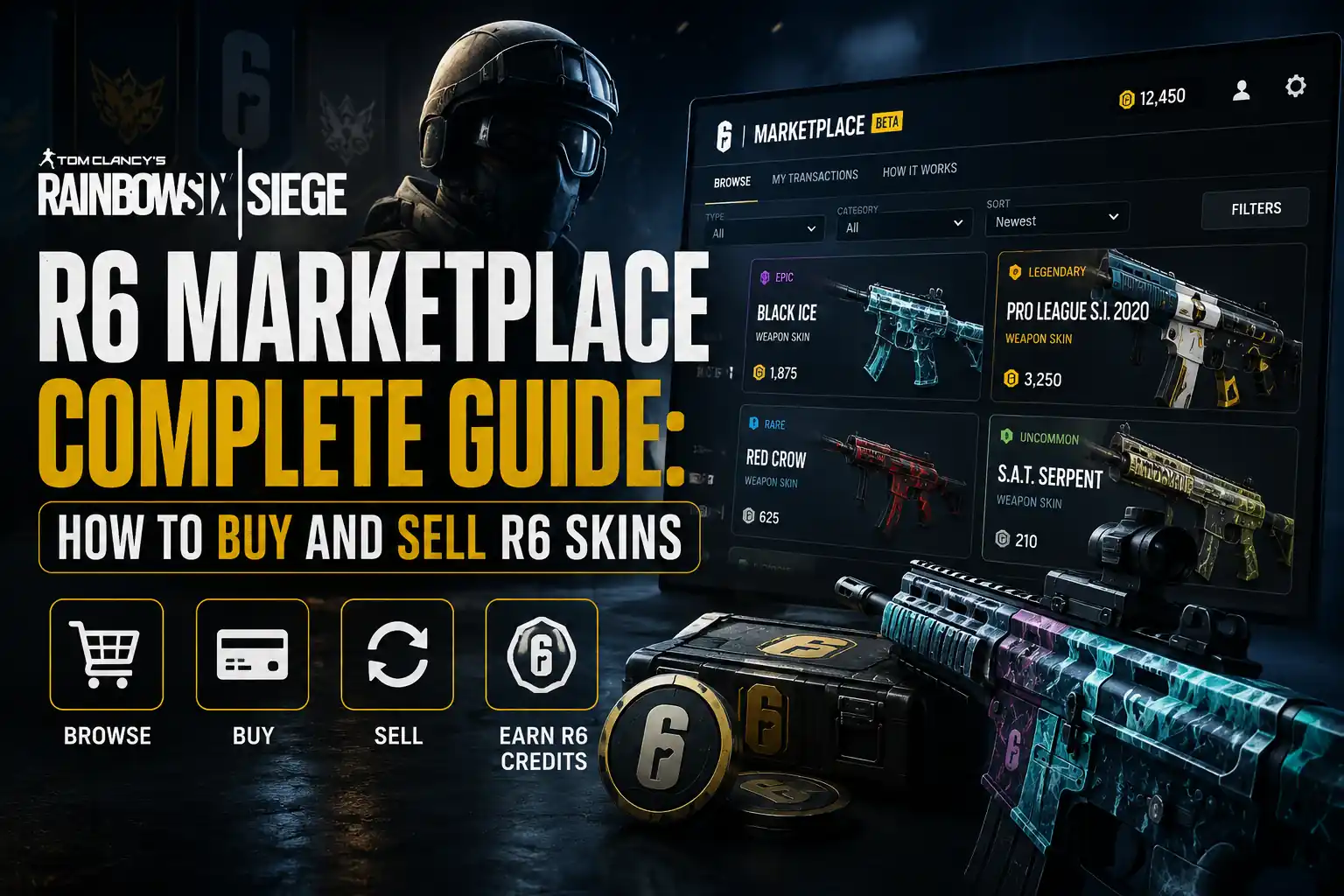
The R6 Marketplace changed how Rainbow Six Siege players interact with cosmetics. Before it existed, missing a limited skin meant losing it forever. Now, players can buy, sell, and trade eligible items using R6 Credits through an official, Ubisoft-managed system.
- What Is the R6 Marketplace?
- Why Ubisoft Introduced the R6 Marketplace
- How the R6 Marketplace Works
- Eligibility Requirements and Account Access
- What Items Are Tradable on the R6 Marketplace
- How to Buy on the R6 Marketplace
- How to Sell on the R6 Marketplace
- Understanding Fees, Pricing, and Dynamic Price Limits
- Item Rarity, Valuation, and Market Trends
- Rarity Tiers and Pricing Factors
- What Drives Prices on the R6 Marketplace
- Most Valuable and Popular Items
- Advanced Trading Strategies and Profit Tips
- Account Security and Scam Prevention
- R6 Marketplace vs Third-Party Trading Sites
- Trade Limits, Rules, and Restrictions
- Cross-Platform Trading and Refund Policy
- The R6 Marketplace Shutdown and Current Status
- R6 Marketplace Relaunch: What to Expect in Year 11
- Impact of the R6 Marketplace on the Siege Economy
- Pros and Cons of the R6 Marketplace
- Conclusion
- FAQs
This guide covers everything — how it works, what you can trade, pricing rules, the 2025 shutdown, and what to expect when it returns in Year 11. Whether you just hit Clearance Level 25 or you’ve been trading since the beta, this is the most current breakdown available.
What Is the R6 Marketplace?
The R6 Marketplace is Ubisoft’s official in-game trading platform built directly into the Rainbow Six Siege ecosystem via Ubisoft Connect. Players use it to buy and sell cosmetic items — weapon skins, operator uniforms, charms, headgear — using R6 Credits as the sole currency.
What makes it different from a standard in-game store is the order-book system. Buyers choose the highest price they are prepared to pay. Sellers set a minimum they’ll accept. When those two numbers align, the transaction completes automatically. No negotiating, no direct player messaging, and no room for the kind of scams that plagued third-party trading sites for years.
It also lets players resell cosmetics they already own — something most gaming platforms don’t allow. Unused duplicates, outdated skins, and unwanted charms become liquid assets rather than dead inventory.
Why Ubisoft Introduced the R6 Marketplace
For most of Siege’s history, players who missed limited-time cosmetics had two options: pay inflated prices on sketchy third-party sites or accept the loss. Both outcomes were bad. Ubisoft recognized the community demand and the security risk of unofficial channels and built a controlled solution.
The platform also made business sense. By charging a transaction fee on every sale, Ubisoft created a revenue channel that doesn’t require selling new content. Players recirculate existing cosmetics, Ubisoft takes a cut, and the game’s economy becomes self-sustaining.
Player engagement deepened, too. When cosmetics carry real tradable value, players treat them as assets rather than purchases, which keeps long-term interest in the game alive well into Siege’s second decade.
How the R6 Marketplace Works
The platform runs as a web-based interface linked to a verified Ubisoft account. Here’s the basic flow:
- A seller lists an item at a minimum acceptable price
- A buyer places an order at a maximum they’re willing to pay
- The system matches both sides automatically when prices overlap
- R6 Credits transfer to the seller; the item moves to the buyer’s inventory
Every step runs through Ubisoft’s servers. There’s no peer-to-peer chat, no handshake trades, and no room for fake listings. Price filters, item search, and full transaction history make the experience clean and transparent for both beginners and experienced traders.
Eligibility Requirements and Account Access
Ubisoft intentionally keeps the entry requirements specific. This isn’t to be restrictive — it’s fraud prevention.
| Requirement | Detail |
| Minimum Age | 13 years or older |
| Clearance Level | Level 25 (roughly 15–25 hours of play) |
| Two-Factor Authentication | Mandatory via Ubisoft Account Security tab |
| Account Standing | No active bans or sanctions |
| Security Changes | 14-day lock after any password or email update |
| Recent Activity | Must have participated in the current season |
The 14-day lock catches one issue new traders often miss — if you recently updated your login credentials, you won’t get instant access. The platform is web-only, with no standalone in-game menu, and it supports PC, PlayStation, and Xbox accounts through a shared Ubisoft login.
What Items Are Tradable on the R6 Marketplace
Eligible Item Categories
Not everything in your inventory qualifies, but the tradable pool is substantial:
- Weapon skins including Black Ice and Glacier
- Operator uniforms and Elite Sets
- Headgear and charms
- Celebration Packs (added during Operation High Stakes in 2025)
- Drone skins, operator portraits, and attachment skins
Non-Tradable and Restricted Items
Several categories sit permanently outside the trading system:
- Base game content
- Ubisoft+ exclusive items
- Items from the current active season (these unlock for trading once the next season releases)
The current-season lock is deliberate. It prevents players from flooding the market with freshly released content and artificially suppressing prices right after launch.
How to Buy on the R6 Marketplace
Step-by-Step Buying Process
- Log in via Ubisoft Connect or the R6 web portal
- Open the Buy tab and select an item category or use the search bar
- Sort listings from low to high to identify the best entry price
- Review the 30-day price history chart before committing
- Set your maximum bid — the system automatically matches you with the lowest-priced seller.
- Wait for the order to fill; faster fills happen when your bid sits close to current ask prices
Buying Tips and Price Strategy
The 30-day chart is your most useful tool. Items spike sharply after content updates, operator reworks, and esports events like R6 SHARE tournaments. Buying during mid-season — when no major content drop is imminent — typically gets you better prices.
Avoid impulse purchases based on hype. A skin that looks valuable the week an operator gets a new bundle often drops in price within two weeks once initial demand settles. Patience consistently outperforms urgency on this platform.
How to Sell on the R6 Marketplace
Step-by-Step Selling Process
- Navigate to the Sell tab and browse your eligible inventory
- Items ineligible for trading appear greyed out — don’t waste time trying to list them
- Select the item and set a minimum asking price based on current market data
- Submit the listing and wait for a matching buyer
- Once sold, R6 Credits land in your account minus the transaction fee
Smart Selling Strategies
Timing matters more than most sellers realize. Marketplace activity reaches its highest levels during evening hours in North America and Europe. Listing during these windows increases buyer competition and can push your final sale price above the floor.
Track whether your item is trending upward or declining before listing. Selling a skin on the way up captures more value than waiting for it to plateau.
Understanding Fees, Pricing, and Dynamic Price Limits
The fee structure depends on which side of the transaction you’re on:
| Role | Fee |
| Seller | 5% deducted from earnings |
| Buyer | No additional fee |
| Minimum Listing Price | 120 R6 Credits |
Beyond fees, the platform uses a dynamic price limit system. Every item has a minimum and maximum price it can be listed at, calculated from recent completed transactions. This prevents extreme outlier listings — you can’t list a Black Ice skin at 10x market value, and nobody can dump rare items at near-zero to manipulate the credit economy.
The system is self-correcting. Price bands shift gradually based on real transaction data, which keeps prices broadly reflective of genuine supply and demand rather than manipulation or credit laundering attempts.
Item Rarity, Valuation, and Market Trends
Rarity Tiers and Pricing Factors
Items fall into loose value tiers based on scarcity:
- Common items — wide availability, lower prices, good for beginners learning the market
- Rare and limited-edition items — discontinued bundles, older season drops, event exclusives
- Legacy skins (Year 1–4) — highest demand, premium pricing due to extremely limited supply
What Drives Prices on the R6 Marketplace
Several factors push prices up or pull them down:
- Operator popularity — Cosmetics tied to high-play-rate operators like Ash, Jäger, and Vigil command more
- Season timing — Prices for items approaching their next season lock often spike as availability tightens
- Esports cycles — Pro League sets and R6 SHARE cosmetics surge around major tournament periods
- Content updates — Operator reworks and map changes spike interest in related cosmetics
Most Valuable and Popular Items
Black Ice consistently ranks as one of the most traded and highest-valued weapon skins on the platform. Pro League skins, elite operator sets, and event-exclusive cosmetics from older seasons all carry significant value. The Fire skin and Glacier variants also maintain strong trading volume.
Advanced Trading Strategies and Profit Tips
Once you understand the basics, the marketplace opens up genuine strategic depth:
- Monitor price history before every transaction — never buy or sell without checking the 30-day trend
- Start with small transactions — new traders should begin with charms or common skins to understand price movement before risking high-value items
- Flip low-demand items carefully — buy items at a dip, hold until seasonal demand returns, then sell
- Use Stats.CC and R6.Tracker — these third-party tools scrape marketplace data and generate price charts Ubisoft’s interface doesn’t natively provide
- Watch volume shifts — a sudden spike in sell orders for a specific item often signals incoming price drops
Account Security and Scam Prevention
The official marketplace eliminates most traditional scam vectors by design — no direct trades, no peer chat, no unverified listings. That said, account-level security still matters.
Enable 2FA without exception. Use a strong, unique password and keep your recovery email current. Never click marketplace-adjacent links from Discord servers, social media, or emails claiming to be Ubisoft — phishing attempts targeting Siege accounts are common. Always access the marketplace through the official Ubisoft Connect portal or the R6 website directly.
R6 Marketplace vs Third-Party Trading Sites
| Feature | R6 Marketplace | Third-Party Sites (e.g., PlayerAuctions) |
| Ubisoft Endorsed | Yes | No |
| Account Ban Risk | None | High |
| Scam Risk | Minimal | Significant |
| Currency | R6 Credits only | Real money |
| Transaction Safety | Automated, verified | Variable |
| Gray-Market Risk | None | Possible (G2A, Kinguin, Eneba) |
Third-party platforms aren’t inherently illegal, but they sit outside Ubisoft’s terms of service. Chargeback fraud upstream of gray-market resellers has caused downstream account flags for Siege players. The official marketplace removes all of that risk.
Trade Limits, Rules, and Restrictions
The platform enforces hard rules to prevent manipulation:
- 20 completed trades maximum per 24-hour window
- 15-day resale cooldown on any item purchased through the marketplace
- Account selling and boosting services remain explicitly prohibited under the Ubisoft Code of Conduct
- Dynamic price bands prevent both extreme overpricing and deliberate price dumping
The 15-day cooldown specifically targets rapid flipping — a tactic where traders buy items low and immediately relist them to extract spread profits before prices stabilize.
Cross-Platform Trading and Refund Policy
Ubisoft accounts link across PC, PlayStation, and Xbox, meaning your tradable inventory appears regardless of which platform you earned items on. This cross-platform access expands the buyer and seller pool significantly, which improves market liquidity and speeds up order matching.
Refunds are not part of the system. Once a transaction completes, both sides consider it final under normal circumstances. If a technical error occurs, Ubisoft Support and the R6Fix platform handle dispute resolution — but these cases are rare given the automated transaction structure.
The R6 Marketplace Shutdown and Current Status
The MongoBleed Security Incident
On December 27, 2025, attackers exploited a vulnerability in Ubisoft’s backend and customer support systems — bypassing the standard login front door entirely. Within hours, roughly two billion R6 Credits were distributed to player accounts across the game, alongside smaller amounts of Renown, Alpha Packs, and cosmetic items.
Ubisoft acknowledged the breach at 09:10 UTC that morning. General game services came back online within 48 hours. The marketplace did not. As of May 2026, it remains offline while Ubisoft completes a full security rebuild.
Ubisoft’s Response and Compensation
Ubisoft responded in several stages. A compensation bundle was rolled out between January 16 and 25, 2026, for players affected by the disruption. On January 30, 2026, Ubisoft published a Player Protection Update outlining ShieldGuard protections and enhanced fraud detection integrated into Year 11 infrastructure. The company has committed to a stronger, more secure relaunch rather than a rushed return.
R6 Marketplace Relaunch: What to Expect in Year 11
Ubisoft has confirmed the marketplace will return during Year 11, though no fixed date exists as of this writing. Industry observers expected an announcement during the Six Invitational 2026 in Paris, which traditionally serves as Ubisoft’s major roadmap reveal event.
When it returns, expect stricter access rules, ShieldGuard fraud detection running across all transactions, and potentially an expanded tradable item pool. Players who have been holding valuable legacy skins may find strong demand waiting on the other side of the relaunch.
Impact of the R6 Marketplace on the Siege Economy
The marketplace didn’t just add a trading feature — it fundamentally changed how players value cosmetics. Skins became assets. Seasonal events gained economic stakes. Veterans found ways to monetize years of accumulated inventory, and newer players gained access to items that would otherwise be unobtainable.
The result is a healthier circulation of cosmetics across the player base without compromising competitive integrity — every traded item is purely visual, with zero gameplay impact.
Pros and Cons of the R6 Marketplace
| Pros | Cons |
| Official, Ubisoft-verified platform | 5% fee on every sale |
| No account ban risk | Credits can’t convert to real money |
| Eliminates scam risk | Current season items locked from trading |
| Cross-platform inventory access | Price volatility on rarer items |
| Secure automated transactions | Minimum listing price of 120 R6 Credits |
| Access to legacy cosmetics | 15-day resale cooldown limits fast flipping |
Conclusion
The R6 Marketplace represents a meaningful shift in how Rainbow Six Siege handles cosmetic value. It gives players real utility from their inventories, reduces the pressure of FOMO-driven purchases, and keeps rare skins in circulation rather than locked behind time-limited events.
Right now, the platform sits offline following the MongoBleed incident. But Ubisoft’s investment in ShieldGuard and the Year 11 rebuild signals a serious commitment to bringing it back stronger. When it returns, the fundamentals covered in this guide — eligibility, fees, item eligibility, pricing mechanics, and trading strategy — will all carry forward.
Use the downtime to understand how the market works. The players who trade smart on day one of the relaunch will be the ones who prepared before it launched.
FAQs
FAQ 1: What is the R6 Marketplace and how does it work?
The R6 Marketplace serves as Ubisoft’s official trading platform for Rainbow Six Siege. Players buy and sell eligible cosmetic items using R6 Credits through an order-book system. Buyers set a maximum price; sellers set a minimum. The system automatically matches and completes transactions without any direct player interaction.
FAQ 2: What are the eligibility requirements to use the R6 Marketplace?
You need to be at least 13 years old, reach Clearance Level 25, enable two-factor authentication, and maintain a Ubisoft account in good standing with no active bans. A 14-day access lock also applies after any password or email change.
FAQ 3: What transaction fees does the R6 Marketplace charge?
Sellers pay a 5% fee deducted from their earnings. Buyers pay no additional fee. The minimum listing price is 120 R6 Credits. So if you sell a skin for 1,000 credits, you receive 950.
FAQ 4: Why is the R6 Marketplace currently offline?
The platform went offline on December 27, 2025, following the MongoBleed security breach, in which attackers distributed approximately two billion R6 Credits to player accounts through a backend exploit. Ubisoft shut the marketplace down to investigate, roll back illegitimate transactions, and rebuild the security infrastructure under the ShieldGuard framework.
FAQ 5: When will the R6 Marketplace return?
Ubisoft has confirmed a Year 11 return but has not announced a specific date. The Six Invitational 2026 in Paris was widely expected to include a roadmap announcement. Monitor official Ubisoft channels for the most current information.
FAQ 6: What items can and cannot be traded on the R6 Marketplace?
Tradable items include weapon skins like Black Ice, Elite Sets, headgear, charms, and Celebration Packs. Items that cannot be traded include base game content, Ubisoft+ exclusives, and anything from the current active season, which unlocks for trading once the next season releases.
FAQ 7: How do prices work and what makes items valuable?
Prices are set by players within dynamic price limits calculated from recent completed transactions. Rarity, operator popularity, season timing, and esports cycles all push prices up or down. Legacy skins from Year 1–4 carry the highest values due to extremely limited supply, while the 30-day price history chart shows whether an item is trending up or declining.
FAQ 8: Is the R6 Marketplace safe, and how does it compare to third-party sites?
The official marketplace is significantly safer than third-party alternatives. Ubisoft’s automated transaction system eliminates fake listings, direct scam attempts, and account ban risk. Third-party platforms like PlayerAuctions or gray-market resellers such as G2A operate outside Ubisoft’s terms of service and carry real account risk. Use Stats.CC or R6.Tracker for price data, but always trade through the official platform.
