
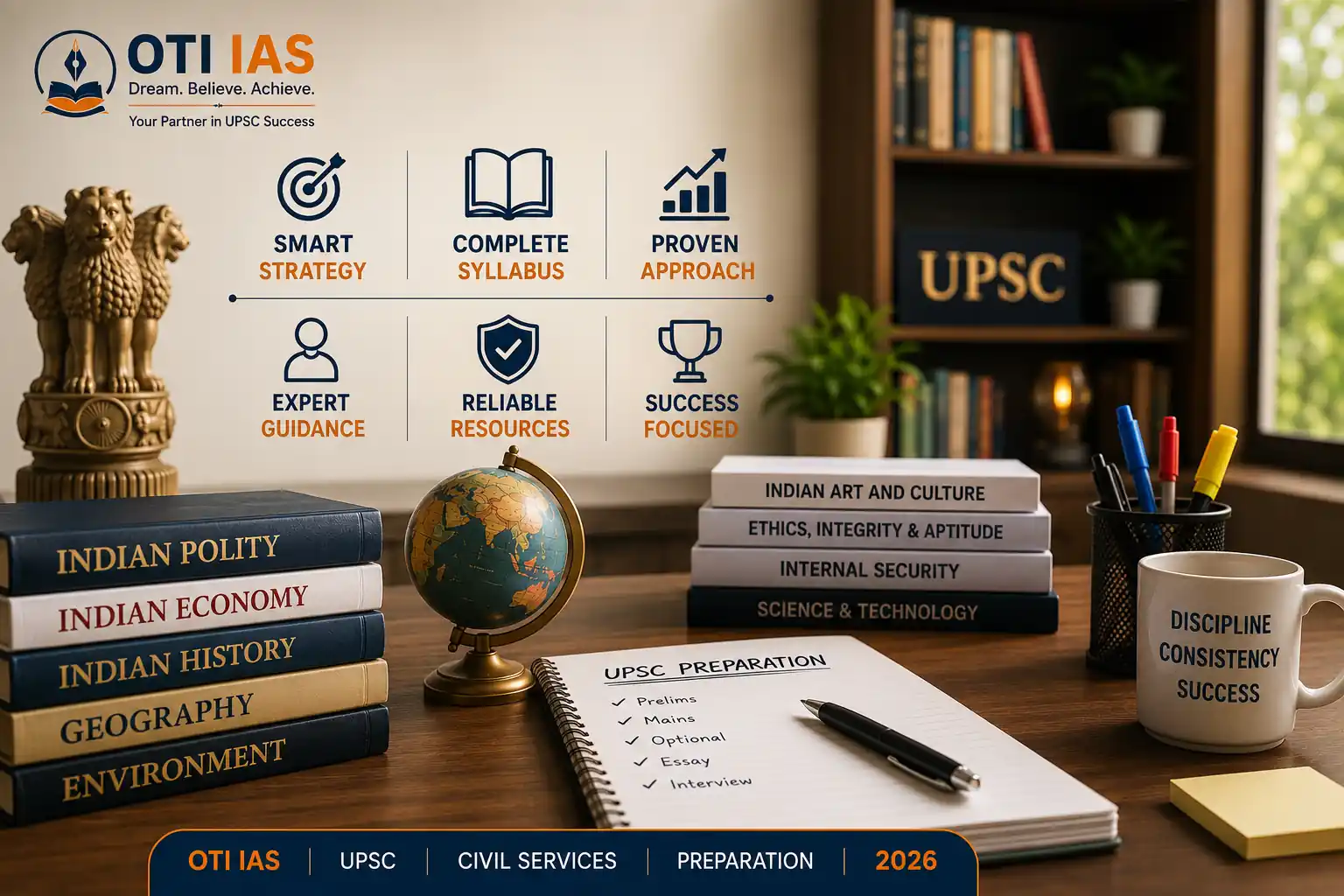
If you’ve been searching for structured UPSC coaching that works beyond the traditional classroom model, OTI IAS has likely appeared on your radar. Short for Online Training Institute for Indian Administrative Services, this platform has grown into one of the more talked-about names among civil services aspirants preparing for IAS, IPS, and IFS positions.
- What Is OTI IAS?
- History and Background of OTI IAS
- Why the UPSC IAS Exam Is So Important
- Why Students Choose OTI IAS
- Key Features of OTI IAS
- Online and Offline Classes
- Experienced Faculty
- Comprehensive Study Material
- Regular Mock Tests and Practice Papers
- Answer Writing Practice
- Current Affairs Coverage
- Personal Mentorship
- OTI IAS Courses Offered
- Foundation Course
- Prelims Course
- Mains Answer Writing Course
- Optional Subject Coaching
- Interview Preparation
- Teaching Methodology of OTI IAS
- Conceptual Clarity Approach
- Personalized Study Plans and Revision Cycles
- Continuous Testing and Feedback
- Technology and Innovation at OTI IAS
- OTI IAS Course Structure and Fee Details
- Admission and Enrollment Process
- OTI IAS for Special Aspirant Groups
- OTI IAS for Beginners
- OTI IAS for Working Professionals
- OTI IAS for Repeat Aspirants
- OTI IAS for NRI Students
- OTI IAS vs Other UPSC Coaching Options
- Success Stories and Track Record
- Common UPSC Mistakes and How OTI IAS Solves Them
- Tips to Maximize Results with OTI IAS
- UPSC Trends 2026
- Is OTI IAS Worth It? Final Verdict
- Conclusion
- FAQs
- What does OTI IAS stand for?
- Is OTI IAS suitable for absolute beginners?
- Can working professionals join OTI IAS?
- Does OTI IAS offer optional subject coaching?
- How does OTI IAS use technology in preparation?
- Are OTI IAS online courses as effective as offline courses?
- What is the success rate of OTI IAS students?
- Can OTI IAS guarantee UPSC selection?
What makes it worth a closer look isn’t just the course catalog — it’s the combination of structured preparation, personalized mentorship, and technology-driven learning that addresses gaps most traditional coaching setups leave open.
This guide covers everything: what the institute offers, who it suits best, how fees work, how it compares to alternatives, and whether it’s genuinely worth your time in 2026.
What Is OTI IAS?
OTI IAS is a digital coaching platform built specifically for UPSC Civil Services Examination preparation. It covers all three stages — Prelims, Mains, and the Personality Test — under one integrated system rather than treating each stage as a separate product.
The platform was designed with a clear gap in mind: students from smaller cities, Tier 2 and Tier 3 towns, and rural areas often have the ability to crack civil services but lack access to quality guidance. Relocating to Delhi or Mumbai for coaching means added costs, stress, and disruption — barriers that shouldn’t determine whether someone gets a fair shot at becoming an IAS officer.
Over the years, the institute has built a faculty team that includes educators with direct UPSC experience and subject-matter specialists across History, Geography, Polity, Economy, Science, and Current Affairs. The result is a platform where first-generation aspirants compete on equal footing with candidates from major urban centers.
History and Background of OTI IAS
The founding mission behind OTI IAS was straightforward: to make UPSC preparation accessible and affordable without cutting corners on quality.
Early on, the institute recognized that most coaching ecosystems were built around Delhi’s geography — students had to be there physically to access the best resources. OTI IAS was built to remove that constraint. It started with a small faculty team, expanded its online infrastructure, and gradually developed a curriculum that maps closely to how UPSC actually tests knowledge — not just what subjects appear on paper.
That evolution matters because the UPSC exam rewards analytical thinking and structured expression, not encyclopedic recall. The institute’s growth reflects an understanding of this shift.
Why the UPSC IAS Exam Is So Important
The Union Public Service Commission conducts the Civil Services Examination annually. It selects candidates for the Indian Administrative Service, Indian Police Service, Indian Foreign Service, and dozens of other Group A and Group B central services.
Every year, over a million students apply. Fewer than a thousand make the final merit list. That ratio makes it one of the most competitive selection processes anywhere in the world.
The exam runs in three stages:
| Stage | Format | Key Requirement |
| Prelims | Objective (MCQ) | Speed, accuracy, elimination |
| Mains | Descriptive (written) | Analytical writing, depth |
| Personality Test | Interview | Communication, clarity, confidence |
Each stage demands a different preparation strategy. Most failures happen not from lack of knowledge but from poor strategy, inconsistent revision, or weak answer writing — exactly where structured coaching makes a measurable difference.
Why Students Choose OTI IAS
The clearest answer: structure and affordability in one place.
Preparing independently for UPSC is possible, but the syllabus is genuinely vast. Without a clear roadmap, most aspirants either overstudy low-priority topics or underestimate areas like Ethics and Essay, which carry significant weightage in Mains.
OTI IAS removes that confusion early. Students get a week-by-week study plan, regular progress checkpoints, and guidance that adjusts based on where they’re struggling — not a generic schedule that treats all students identically.
Cost is another factor. Quality offline coaching in Delhi can run well above ₹1–1.5 lakh annually when you add tuition, accommodation, and travel. OTI IAS brings the preparation quality closer to that standard at a fraction of the total cost, which is particularly meaningful for students financing their own preparation.
Key Features of OTI IAS
Online and Offline Classes
The platform supports both live online sessions and recorded video content, giving students the flexibility to review complex topics more than once. For those near a physical center, offline classroom options are available. This hybrid learning model is increasingly the standard in serious UPSC preparation — static schedules alone don’t work for everyone.
Experienced Faculty
Faculty members bring subject depth across the core GS papers — History, Geography, Polity, Economy, Science and Technology, and Current Affairs. Teaching style emphasizes clarity over volume. Complex concepts get broken into smaller, digestible parts rather than presented as dense blocks of information.
Comprehensive Study Material
Notes are organized around the UPSC syllabus structure and written in clear, accessible language. Students don’t need to cross-reference five different books for a single topic — the material consolidates what’s necessary and filters out what isn’t relevant to the exam pattern.
Regular Mock Tests and Practice Papers
Mock tests here go beyond simple question banks. They mirror actual UPSC difficulty levels, are timed, and include detailed post-test analysis. Topic-wise practice tests build familiarity gradually, while full-length mocks simulate real exam pressure. Performance dashboards track weak areas over time, not just individual test scores.
Answer Writing Practice
This is where many aspirants lose marks even when their knowledge base is solid. OTI IAS integrates answer writing from the foundation stage — not as an afterthought before Mains. Regular assignments with mentor feedback help students develop logical structuring, analytical depth, and the ability to weave current affairs into GS paper answers effectively.
Current Affairs Coverage
Daily, monthly, and annual current affairs coverage connects recent events directly to UPSC syllabus themes. Rather than flooding students with news, the approach filters what’s examinable and explains its relevance to Polity, Economy, Environment, or International Relations.
Personal Mentorship
Each student gets access to mentors who design individualized study plans based on actual diagnostic results — not assumptions. These mentors track progress, intervene when preparation gaps appear, and help re-calibrate strategy when needed.
OTI IAS Courses Offered
Foundation Course
Built for students starting from scratch, this course covers Ancient and Modern Indian History, Polity, Economy, Geography, Environment, Science, and Ethics. Concepts are introduced progressively so students build a strong base before tackling higher-difficulty material.
Prelims Course
Focused entirely on the first stage, this course prioritizes MCQ accuracy, elimination techniques, and time management. Crash courses are available for re-attempters looking for intensive revision before the exam window.
Mains Answer Writing Course
Probably the most undervalued component of civil services prep. This program teaches students how to structure answers under time pressure, integrate current affairs organically, and write essays that demonstrate analytical clarity rather than just factual recall.
Optional Subject Coaching
Optional subjects like Public Administration, Sociology, Geography, and Political Science receive dedicated coverage with faculty who specialize in those areas. A well-scored optional paper can significantly shift a candidate’s final rank.
Interview Preparation
The Personality Test carries 275 marks. OTI IAS prepares students through mock panels, DAF (Detailed Application Form) analysis, situational judgment exercises, and communication coaching. Candidates practice handling unpredictable questions while maintaining composure and clarity.
Teaching Methodology of OTI IAS
Conceptual Clarity Approach
The teaching philosophy here is built around understanding, not memorization. UPSC questions — particularly in Mains — test whether candidates can think through problems and articulate positions clearly. Rote learning produces surface answers. Conceptual clarity produces the kind of analytical writing that evaluators reward.
Personalized Study Plans and Revision Cycles
When a student joins, a diagnostic assessment identifies their current knowledge level, available study hours, and weaker subject areas. The resulting study plan isn’t a template — it reflects that specific student’s preparation state. Revision cycles are built in so material doesn’t fade between initial learning and the actual exam.
Continuous Testing and Feedback
Weekly tests, performance dashboards, and post-test feedback loops create a continuous improvement cycle. Students don’t just identify weak areas — they get actionable guidance on how to address them before the next evaluation.
Technology and Innovation at OTI IAS
In 2026, OTI IAS integrates AI-driven performance analytics into its preparation system. After the initial diagnostic test, the platform generates an adaptive learning path that updates as a student progresses — prioritizing areas that need more work rather than following a fixed schedule.
Mobile-first dashboards let students track performance, access material, and attend sessions from anywhere. VR-based case study simulations are available for interview preparation, allowing candidates to practice in realistic administrative scenarios before facing an actual panel.
This isn’t technology for its own sake. Aspirants who use these tools report faster identification of preparation gaps and better retention compared to static study approaches.
OTI IAS Course Structure and Fee Details
| Course Component | Duration | Fee Range |
| Foundation Program | 12–18 months | Moderate |
| Prelims Test Series | 3–6 months | Affordable |
| Main Answer Writing | 4–6 months | Moderate |
| Optional Subject | 3–5 months | Varies by subject |
| Interview Preparation | 1–2 months | Separate module |
Scholarships and merit-based discounts are available. Always verify current pricing directly with the institute before enrollment, as fees are updated periodically.
Admission and Enrollment Process
Registration is straightforward — students apply online, select their batch type (Prelims, Mains, Interview, or Integrated), submit documentation, and complete payment through online or offline modes. After enrollment, access to live classes, recorded sessions, and study material is available across multiple platforms immediately.
OTI IAS for Special Aspirant Groups
OTI IAS for Beginners
The Foundation Course is built for students who have no prior UPSC preparation. It introduces each subject from the ground up and doesn’t assume background knowledge. Mentor guidance during the early stage prevents the most common beginner mistake — studying without a clear direction.
OTI IAS for Working Professionals
Weekend batches and recorded sessions make it practical for professionals to prepare without leaving their jobs. The flexibility to study at off-peak hours — and rewatch classes when schedules conflict — is a genuine advantage over rigid offline programs.
OTI IAS for Repeat Aspirants
Re-attempters bring prior preparation but often carry unaddressed gaps from previous attempts. Personalized mentorship at OTI IAS identifies exactly where past strategies fell short and builds corrective workflows — which can meaningfully compress preparation time for a second or third attempt.
OTI IAS for NRI Students
Batches scheduled across EST and PST time zones serve Indian students abroad in the US, UK, Canada, Australia, and the Middle East. NRI aspirants also benefit from specialized current affairs sessions that bridge gaps between international news exposure and India-specific policy developments.
OTI IAS vs Other UPSC Coaching Options
| Feature | OTI IAS | Traditional Offline Coaching |
| Mentorship | Personalized 1-on-1 | Generic classroom |
| Flexibility | Online, offline, hybrid | Mostly offline, fixed schedule |
| Current Affairs | Integrated with the syllabus | Often a separate module |
| Technology | AI analytics, VR simulations | Limited or none |
| Accessibility | Tier 2/3 cities, NRI students | Primarily metro-based |
| Fee (total cost) | Competitive, no relocation cost | Higher with living expenses |
Compared to larger names like Vision IAS or Vajiram, the key differentiator isn’t the brand — it’s the personalization and accessibility at a lower all-in cost.
Success Stories and Track Record
Students who have completed the integrated program at OTI IAS have cleared IAS, IPS, and IFS examinations on their first attempts. Several have secured positions in the top ranks on the UPSC merit list. Optional subject coaching has produced notably strong results, with candidates crediting structured guidance for scores that shifted their final ranking significantly.
These aren’t isolated cases — they reflect what consistent preparation with strong mentorship and regular feedback can produce.
Common UPSC Mistakes and How OTI IAS Solves Them
Most UPSC failures trace back to a handful of avoidable habits:
- Over-reading without revision — collecting more books than anyone could genuinely absorb
- Delaying answer writing — treating it as something to practice only in the final months
- Ignoring current affairs integration — studying news separately from the syllabus instead of thematically
- No personalized feedback — following generic coaching programs that don’t identify individual weak spots
OTI IAS addresses each of these directly: curated materials replace book overload, writing practice starts at the foundation stage, current affairs are linked thematically to core subjects, and mentorship ensures feedback is specific to each student.
Tips to Maximize Results with OTI IAS
Getting the most from any coaching program comes down to how you use it, not just whether you attend:
- Build a daily study routine and protect it — consistency outperforms intensity
- Engage actively in doubt-clearing sessions rather than just watching lectures passively
- Treat every mock test as a real exam; analyze performance honestly afterward
- Revise regularly — don’t wait until the exam window to revisit earlier topics
- Read one good newspaper daily and connect it to syllabus themes, not just current events
UPSC Trends 2026
UPSC question papers in 2026 increasingly reward multidimensional analysis — answers that connect governance, ethics, technology, and current affairs rather than treating subjects in isolation. AI-assisted personalized learning and hybrid course models are now standard tools among top-performing aspirants.
Platforms that integrate these elements into preparation — rather than offering them as add-ons — are showing measurable advantages in student outcomes.
Is OTI IAS Worth It? Final Verdict
For aspirants who need structured guidance, personalized feedback, and the flexibility to prepare without relocating, OTI IAS offers a strong value proposition. The combination of adaptive technology, experienced faculty, and integrated course design addresses most of what causes UPSC preparation to break down.
It’s not a guaranteed path — no coaching program is. Success still depends on consistent self-study, disciplined revision, and genuine effort. But as a framework for channeling that effort productively, particularly for first-generation aspirants, working professionals, and students outside major metros, it delivers more per rupee than most alternatives.
Conclusion
OTI IAS has built a preparation system that responds to how the UPSC exam actually works in 2026 — rewarding conceptual clarity, analytical writing, and integrated thinking across subjects. Its combination of structured courses, AI-driven learning tools, personalized mentorship, and flexible delivery makes it a credible option for serious aspirants across different backgrounds and locations.
If your civil services goal is real and your preparation strategy needs more structure, exploring what OTI IAS offers is a practical next step — not just another coaching option to scroll past.
FAQs
What does OTI IAS stand for?
OTI IAS stands for Online Training Institute for Indian Administrative Services. It is a digital coaching platform designed specifically for UPSC Civil Services Examination preparation, covering Prelims, Mains, and the Personality Test.
Is OTI IAS suitable for absolute beginners?
Yes. The Foundation Course starts from the basics and builds knowledge progressively. Mentor guidance during the early stage helps beginners avoid the most common pitfall — studying hard without a clear direction.
Can working professionals join OTI IAS?
Absolutely. Weekend batches and recorded sessions make it practical to prepare alongside a full-time job. Students can attend live sessions or watch recordings based on their availability without falling behind.
Does OTI IAS offer optional subject coaching?
Yes. Optional subjects, including Public Administration, Geography, Sociology, and Political Science, receive dedicated coaching from subject specialists. A strong optional paper score can significantly improve a candidate’s final rank.
How does OTI IAS use technology in preparation?
The platform uses AI-driven performance analytics to generate adaptive learning paths after an initial diagnostic test. Mobile-first dashboards track progress, and VR simulations support interview preparation by replicating realistic administrative scenarios.
Are OTI IAS online courses as effective as offline courses?
For most aspirants, yes. Online courses include live classes, recorded sessions, PDFs, mock tests, and mentor access — comparable to offline quality. Hybrid learning, combining occasional offline sessions with online study, tends to produce the strongest results.
What is the success rate of OTI IAS students?
OTI IAS has produced candidates who cleared IAS, IPS, and IFS examinations on their first attempt and secured high ranks on the UPSC merit list. Optional subject coaching has been particularly cited for contributing to rank improvements.
Can OTI IAS guarantee UPSC selection?
No coaching institute can guarantee selection — and any that claims otherwise should be treated with skepticism. OTI IAS provides structure, guidance, and tools. The actual result depends on the student’s consistency, self-study discipline, and quality of effort over time.
