
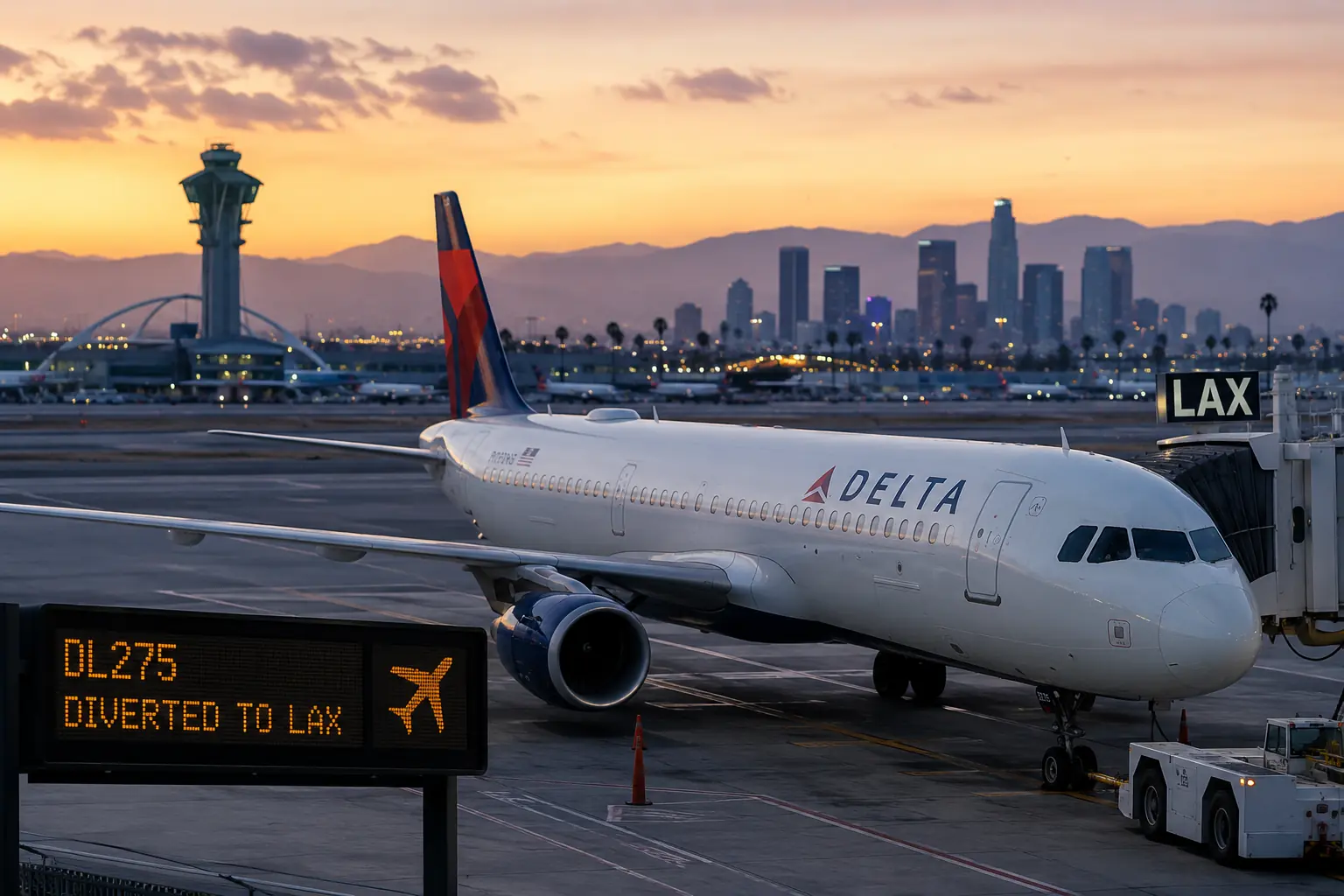
On May 27, 2025, Delta flight DL275 diverted to LAX after the flight crew detected a critical malfunction in the engine anti-ice system mid-flight over the North Pacific. What began as a routine 13-hour long-haul service from Detroit to Tokyo turned into one of the most discussed aviation incidents of 2025. All 287 passengers landed safely at Los Angeles International Airport — but the story behind that decision reveals exactly how modern aviation safety is supposed to work.
- What Is Delta Flight DL275? Route, Aircraft & Schedule Overview
- Hour-by-Hour Timeline: What Happened on Delta Flight DL275
- What Caused the Diversion? Engine Anti-Ice System Failure Explained
- Why LAX? The Strategic Logic Behind the Diversion Airport Choice
- Captain’s Decision & Aviation Safety Protocols: How the Crew Responded
- Passenger Experience: Reactions, Emotions & What Happened at LAX
- Delta’s Official Response, Compensation & Passenger Rights
- Technical Deep Dive: Airbus A350-900 Safety Systems & Redundancy
- Financial Impact of the DL275 Diversion
- Could This Have Been Prevented? AI, Predictive Maintenance & the Future of Aviation Safety
- DL275 Diversion vs. Other Notable Pacific Flight Diversions
- Status Update: Delta DL275 & Aircraft N508DN — Current Status
- Conclusion
- FAQs
- FAQ 1: Was Delta Flight DL275 an emergency landing or a precautionary diversion?
- FAQ 2: What caused Delta Flight DL275 to divert to LAX?
- FAQ 3: Where exactly was the aircraft when the diversion was declared?
- FAQ 4: Why did the crew choose LAX and not a closer airport?
- FAQ 5: How long did the entire diversion flight take?
- FAQ 6: Were passengers on DL275 compensated?
- FAQ 7: How much did the DL275 diversion cost Delta Airlines?
- FAQ 8: Has aircraft N508DN returned to service, and is DL275 still flying the Detroit–Tokyo route?
This report covers everything: the verified timeline, the technical cause, why the crew chose LAX, what passengers experienced, and what compensation rights diverted travelers actually have.
What Is Delta Flight DL275? Route, Aircraft & Schedule Overview
Delta Flight DL275 connects Detroit Metropolitan Wayne County Airport (DTW) with Tokyo Haneda Airport (HND) — a trans-Pacific route covering roughly 6,200 miles. The flight typically runs just over 13 hours, making it one of the longer international routes in Delta’s network.
The aircraft assigned to this route is the Airbus A350-900, registered as N508DN. Powered by twin Rolls-Royce Trent XWB engines, the A350-900 is purpose-built for ultra-long-range routes. It carries up to 287 passengers across three cabins — Delta One, Premium Select, and Main Cabin.
Delta holds both ETOPS-180 and ETOPS-370 certification on this route. That certification determines which alternate airports the crew must be able to reach within a set flight time — a detail that becomes critical when something goes wrong over the ocean.
On May 27, the flight pushed back from Gate A46 with a short delay caused by a late inbound aircraft on an Amsterdam rotation. Nobody on board had any reason to expect what came next.
Hour-by-Hour Timeline: What Happened on Delta Flight DL275
Here is the verified sequence of events based on flight tracking data and official reports:
| Time | Event |
| 15:53 EDT, May 27 | DL275 departs Detroit (delayed due to late Amsterdam inbound) |
| ~23:30 EDT | Aircraft cruising at 38,000 ft; the anti-ice system’s’s abnormal indication appears |
| ~23:35 EDT | Flight crew begins engine malfunction checklist; Delta Operations Center notified via ACARS |
| ~23:45 EDT | The captain declares a diversion; the aircraft turns southwest toward California |
| +5 hours | Return flight across the Pacific toward the West Coast |
| 01:08 AM PDT, May 28 | DL275 lands on Runway 06R, LAX |
| ~02:00 AM PDT | Passengers begin deplaning; Delta ground staff activate passenger assistance protocols |
Total airborne time reached approximately 12 hours and 15 minutes. The diversion point sat around 620 nautical miles southwest of Anchorage, Alaska — deep in remote oceanic airspace with very limited nearby airport options.
What Caused the Diversion? Engine Anti-Ice System Failure Explained
At 38,000 feet, outside temperatures drop to between minus 50°C and minus 60°C. At those extremes, moisture in the air can freeze directly onto engine surfaces — specifically the fan blades, inlet areas, and sensor components.
The engine anti-ice system prevents this by routing hot compressed air from the engine’s compressor stage to keep those critical surfaces warm. When the left-wing anti-ice valve began showing irregular behavior and triggering emergency flags, the crew faced a clear decision.
Continuing across the North Pacific with a compromised anti-ice system wasn’t an acceptable option. Ice buildup restricts airflow into the engine, reduces thrust output, and in a worst-case scenario, causes fan blade damage or an engine surge. On a flight crossing thousands of miles of open ocean, that risk — however small — becomes non-negotiable under commercial aviation regulations.
The crew followed their training precisely. The malfunction checklist ran. The Delta Operations Center received notification through ACARS. Then the captain made the call.
Why LAX? The Strategic Logic Behind the Diversion Airport Choice
Diverting over the Pacific isn’t like pulling off a highway. Pilots evaluate multiple factors simultaneously before selecting an alternate airport. Alaska was considered, but cold, snowy conditions there would have made landing with a compromised anti-ice system a worse situation, not a better one.
Los Angeles made sense for three specific reasons.
Technical Infrastructure at LAX
LAX is a certified Airbus A350 maintenance hub with 24/7 Rolls-Royce Trent XWB engine support and replacement parts inventory on site. The moment N508DN landed, the right engineers and tools were already there. No waiting. No logistics scramble.
Passenger Convenience Factors
With multiple daily LAX-to-Tokyo flights operating through LAX, Delta could rebook 287 passengers relatively quickly. Extended layover accommodation, Tokyo connecting flights, and passenger welfare infrastructure exist at scale at one of the world’s busiest international airports in a way smaller airports simply cannot match.
Emergency Readiness at LAX
Runway 06R was cleared for arrival. LAFD Air Ops positioned fire engines and paramedics on the tarmac — standard procedure for any precautionary diversion involving a widebody aircraft. Ground crew guided the aircraft to Gate 144 without incident. The landing itself was completely smooth.
Captain’s Decision & Aviation Safety Protocols: How the Crew Responded
What often gets missed in coverage of incidents like this is the procedural precision behind what looks like a dramatic moment.
The captain didn’t simply decide to turn around. The ETOPS alternate airport criteria — built into Delta’s operational planning — define exactly which airports qualify as viable diversion points based on distance, facilities, and weather. The crew assessed system degradation against those criteria, communicated with the Delta Operations Center via ACARS, coordinated with air traffic control, and executed a controlled, deliberate flight toward Los Angeles.
No emergency declaration was issued. No oxygen masks deployed. Flight attendants continued normal cabin service and kept passengers informed. That calm wasn’t accidental — it reflects exactly how flight crew training and safety culture are designed to function.
Passenger Experience: Reactions, Emotions & What Happened at LAX
From the cabin side, the experience was disorienting rather than frightening. Most passengers had been asleep when the aircraft changed course. The first sign that something was off came from the flight map — the plane icon was pointing the wrong direction.
The captain’s intercom announcement described a technical issue requiring a precautionary stop in Los Angeles. Some passengers clapped. Others went quiet. Social media — including a Reddit thread and clips shared on X — captured the mood inside the cabin fairly accurately: tense, uncertain, but not panicked.
Flight attendants distributed bottled water and stayed visible throughout. Business class and economy class passengers alike described crew professionalism as the defining factor that kept anxiety manageable during the five additional hours it took to reach LAX.
Once on the ground, Delta ground teams began rebooking passengers and coordinating hotel accommodations for those who needed rest before the next available Tokyo departure.
Delta’s Official Response, Compensation & Passenger Rights
Delta issued a statement describing the diversion as made “out of an abundance of caution,” confirming all passengers were safe and that no injuries occurred. The airline committed to rebooking affected travelers within 24 to 48 hours and offered meal vouchers and hotel accommodations.
Business class passengers received Delta Premium upgrade options on the next available flight. Some travelers reported communication delays in the first hour after landing, though most acknowledged Delta’s ground staff handled the logistics competently once the process started.
Know your rights if your flight is diverted:
- Airlines must rebook you on the next available flight at no extra cost
- Meal vouchers are standard for diversions involving extended delays
- Hotel accommodation applies when an overnight stay becomes necessary
- US DOT regulations differ from EU261 — domestic passengers have fewer guaranteed protections than international travelers flying through European rules
- Travel insurance claims can cover additional costs not covered by the airline
- Delta’s goodwill gestures in this case included Delta Premium upgrades, which go beyond minimum obligations
Technical Deep Dive: Airbus A350-900 Safety Systems & Redundancy
The A350-900 is not a fragile aircraft. Its onboard computers monitor engines, fuel lines, cabin pressurization, and dozens of other systems continuously. Fault detection happens in real time, with alerts fed to pilots and logged for ground teams through ACARS.
What the DL275 incident exposed, however, was a gap between detection and prevention. The anti-ice system failure cascade — possibly involving more than a single valve according to post-landing diagnostics run through Axis Intelligence data — was caught in flight. But with AI-powered predictive maintenance modules now available to major carriers, patterns leading to failures like this one can theoretically be identified hours before departure.
The A350-900’s redundancy architecture meant the aircraft remained stable throughout. It maintained proper altitude, speed, and fuel reserves across the entire five-hour diversion flight. That’s the system working as designed.
Financial Impact of the DL275 Diversion
Aviation analysts estimated Delta’s total cost from this diversion at approximately $2.3 million, broken down across several categories:
| Cost Category | Estimated Impact |
| Flight delay penalties | Significant |
| Excess fuel usage (5-hour reroute) | High |
| Maintenance inspections and repairs | Variable |
| The hotel stays for 287 passengers | Moderate |
| Meal vouchers and rebooking costs | Moderate |
| Airline reputation considerations | Indirect |
Beyond the dollar figure, the operational disruption rippled across DTW-HND scheduling for several days while N508DN remained in the maintenance hangar at LAX.
Could This Have Been Prevented? AI, Predictive Maintenance & the Future of Aviation Safety
This is the uncomfortable question that follows any avoidable disruption.
Predictive maintenance platforms using real-time sensor data analysis can flag irregular patterns in engine health — including anti-ice system behavior — as early as 3 to 6 hours before takeoff. AI-driven diagnostics connected to Connected Aircraft systems would have flagged the Trent XWB irregularity during pre-flight checks, potentially preventing the departure entirely.
Several major carriers are already integrating these tools at scale. Delta has invested in smarter aviation technology, but the DL275 incident suggests reactive maintenance still plays too large a role on high-risk transpacific routes. The FAA investigation that followed will likely accelerate pressure on carriers to adopt more proactive monitoring standards.
DL275 Diversion vs. Other Notable Pacific Flight Diversions
Transpacific diversions are uncommon but not unprecedented. For context:
- A Delta 767 en route to Seoul returned to Detroit after a separate system fault the previous year
- A United Dreamliner diverted to Anchorage due to similar icing concerns
- Industry-wide diversion rates sit at roughly 1 to 3% of all commercial flights annually — translating to thousands of unscheduled landings globally each year
What distinguishes the DL275 case is the combination of aircraft type, remote diversion point, and the efficiency of the LAX response. Most oceanic diversions involve longer response windows. This one ran close to the textbook.
Status Update: Delta DL275 & Aircraft N508DN — Current Status
Following the diversion, N508DN remained in the maintenance hangar at LAX for a full technical inspection. Rolls-Royce engineers conducted root cause analysis on the Trent XWB anti-ice system. Delta’s official maintenance reports have not publicly disclosed the full findings, though the aircraft has since returned to service.
DL275 continues to operate the DTW-HND route. Delta operations on the transpacific schedule normalized within days of the incident.
Conclusion
The Delta flight DL275 diverted lax incident at LAX is not a story about something going terribly wrong. It’s a demonstration of aviation safety working exactly as designed. A sensor flagged an issue. Pilots followed the procedure. The crew chose the safest viable airport. Every passenger reached their destination safely.
The deeper lesson sits in the financial and logistical cost — $2.3 million spent because a fault wasn’t caught before departure. As AI diagnostics and proactive maintenance tools become standard, incidents like this will become preventable rather than merely manageable. That shift is already underway across the industry, and DL275 accelerated the conversation.
FAQs
FAQ 1: Was Delta Flight DL275 an emergency landing or a precautionary diversion?
It was a precautionary diversion, not an emergency landing. Delta described the decision as made “out of an abundance of caution.” No emergency was formally declared, and the aircraft landed normally without incident.
FAQ 2: What caused Delta Flight DL275 to divert to LAX?
A malfunction in the Rolls-Royce Trent XWB engine’s anti-ice system triggered the diversion. Flying over the Bering Sea at high altitude with a compromised anti-ice system created an unacceptable icing risk that made continuing to Tokyo impossible under safety regulations.
FAQ 3: Where exactly was the aircraft when the diversion was declared?
The aircraft was approximately 620 nautical miles southwest of Anchorage, Alaska, in remote North Pacific oceanic airspace — well beyond the point where turning back to Detroit was a practical option.
FAQ 4: Why did the crew choose LAX and not a closer airport?
Alaska airports were ruled out due to cold, snowy conditions that would worsen the anti-ice situation. LAX offered certified A350 maintenance facilities, 24/7 Trent XWB support, long runways suitable for a heavy widebody, and full emergency readiness — making it the safest and most practical choice.
FAQ 5: How long did the entire diversion flight take?
The total airborne time reached approximately 12 hours and 15 minutes. After the diversion point, the aircraft flew roughly five additional hours westward toward the California coast before landing at LAX.
FAQ 6: Were passengers on DL275 compensated?
Yes. Delta provided meal vouchers, hotel accommodations, and rebooking on the next available Tokyo flights. Business class passengers received Delta Premium upgrade options. Travelers with travel insurance were also eligible to file additional claims under their policy terms.
FAQ 7: How much did the DL275 diversion cost Delta Airlines?
Aviation analysts estimated the total cost at approximately $2.3 million, covering excess fuel, maintenance inspections, passenger rebooking, hotel stays, meal vouchers, and flight delay penalties.
FAQ 8: Has aircraft N508DN returned to service, and is DL275 still flying the Detroit–Tokyo route?
Yes on both counts. N508DN completed its maintenance inspection at LAX and returned to service. Delta Flight DL275 continues to operate the Detroit–Tokyo Haneda route as scheduled.
