
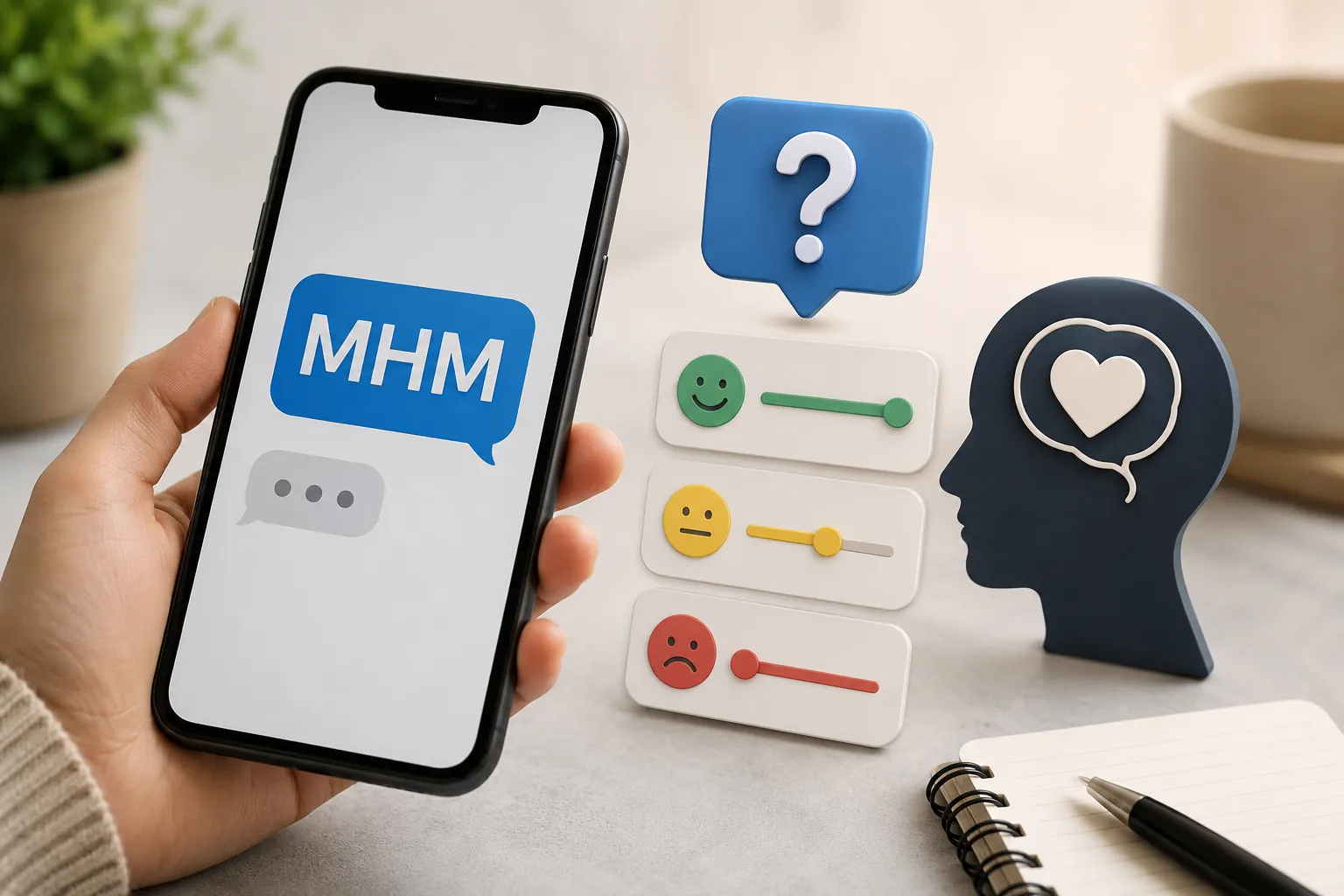
MHM means agreement or acknowledgment — the written version of the sound people make when they nod and say “mm-hmm” out loud. It signals “yes,” “I hear you,” or “I’m listening,” depending on the situation. Unlike typing a plain “yes,” mhm carries tone, mood, and emotional weight that shift based on context and punctuation.
- What Does MHM Mean?
- Where Does MHM Come From?
- Is MHM a Slang Word, Typo, or Intentional Usage?
- Different Meanings of MHM in Text
- Casual Agreement
- Polite Acknowledgment
- Skeptical or Dismissive Response
- Romantic or Flirty Use
- Professional Use
- MHM Meaning from a Girl
- How Tone, Punctuation, and Emojis Change MHM’s Meaning
- MHM vs MM-HMM — What’s the Difference?
- Cultural and Platform-Specific Usage of MHM
- How to Reply When Someone Says MHM
- When NOT to Use MHM
- Polite and Professional Alternatives to MHM
- Conclusion
- FAQs
Three letters. Countless interpretations. Here’s everything you need to know.
What Does MHM Mean?
At its core, mhm is a nonverbal affirmation in text form. It functions as a digital nod — a quick way to confirm receipt of information without typing a full sentence.
The word doesn’t stand for anything. It’s not an acronym. It’s a paralinguistic text — a written attempt to capture a vocal sound. Linguists classify it as an interjection, the same category as “oh,” “hmm,” and “ah.”
What separates mhm from a simple “yes” is its non-committal quality. It confirms you heard something, but it doesn’t necessarily mean you’re enthusiastic or fully on board.
Common meanings at a glance:
| Meaning | Example Context |
| Agreement | “Mhm, sounds good.” |
| Acknowledgment | “Mhm, I got your message.” |
| Neutral listening | “Mhm, keep going.” |
| Skepticism | “Mhm… sure you did.” |
| Low-effort response | “Mhm.” (nothing more) |
Where Does MHM Come From?
The spoken version, mm-hmm, dates back to at least 1934 in recorded English. It existed long before smartphones or social media — used in phone calls, classrooms, and everyday conversation as a casual way to show someone you were following along.
The written form, mhm, gained traction in the early 2000s with the rise of platforms like AOL Instant Messenger and MSN Messenger. The first entry on Urban Dictionary for MHM dates to 2004, which lines up with the explosion of instant messaging culture.
Early text messaging also played a role. Typing “yes” on an old keypad required nine button clicks. Typing “MHM” took only four. That efficiency helped it spread fast.
From SMS to WhatsApp, Facebook Messenger, and eventually TikTok comments and Instagram DMs, mhm traveled across every platform. Gen Z and Millennials absorbed it into everyday digital language, where it now lives as one of the most common minimal acknowledgment texts online.
Is MHM a Slang Word, Typo, or Intentional Usage?
MHM is not slang in the traditional sense. It doesn’t belong in the same category as LOL, BRB, or other internet abbreviations. Those are shortened forms of real phrases. MHM is a phonetic sound written down.
It’s also not a typo or autocorrect accident. Most people type it deliberately. Some keyboards will try to autocorrect it to “hmm” or “mm,” which changes the meaning entirely — so watch for that.
The reason it feels informal is that it mirrors natural speech. People say mm-hmm in relaxed, conversational settings, so when it appears in text, it carries that same casual, low-pressure energy.
Different Meanings of MHM in Text
Casual Agreement
The most common use. When a friend asks, “Pizza tonight?” and you reply “Mhm!” — that’s simple, friendly confirmation. It fits naturally in conversations with siblings, close friends, and gaming chats. The tone is light and easy.
Polite Acknowledgment
Sometimes, mhm means “I hear you” without adding more. A friend vents about a bad day. You reply “mhm” to show you’re listening and following. It signals empathy and attention without interrupting their flow.
Skeptical or Dismissive Response
Tone flips here. If someone says something questionable and you reply “Mhm…” with trailing ellipses — that communicates doubt, disbelief, or mild sarcasm. The same three letters now push back instead of agreeing. Context and punctuation do all the work.
Romantic or Flirty Use
In romantic conversations, mhm often carries soft, intimate energy. Paired with a or, it reads as playful or coy. In a DM with someone you like, “Mhm ” signals interest without saying too much. It’s low-key flirting through minimal words.
Professional Use
This is where mhm gets risky. In a Slack message, a work email, or a team chat, replying “mhm” to a manager’s request can read as lazy, dismissive, or unprofessional. Workplace communication requires clarity. Stick to “Understood,” “Got it,” or “Confirmed” in formal settings.
MHM Meaning from a Girl
When a girl texts mhm, the meaning depends almost entirely on tone cues — punctuation, emojis, timing, and her usual communication style.
- “Mhm “ — friendly, warm, genuinely agreeable
- “mhm” (plain, lowercase) — neutral, listening, not excited
- “Mhm…” — possibly annoyed or unconvinced
- “Mhm “ — flirty, playful, inviting more conversation
- “Mhm.” (with a period) — firm, topic closed, possibly cold
The universal rule: if someone who is usually expressive suddenly sends a bare “mhm,” that shift in behavior is a bigger signal than the word itself. Digital communication habits vary, but a change in pattern always means something.
How Tone, Punctuation, and Emojis Change MHM’s Meaning
Punctuation transforms mhm completely. The same word reads differently based on what follows it:
| Version | Tone | What It Signals |
| mhm | Neutral | Casual acknowledgment |
| mhm! | Positive | Enthusiastic agreement |
| mhm… | Hesitant | Uncertainty or doubt |
| mhm. | Closed | Done talking, possibly annoyed |
| mhm? | Curious | Needs clarification |
| mhm | Warm | Friendly and engaged |
| mhm | Flirtatious | Playful, coy |
Emojis act as tone-of-voice indicators in text. Without them, mhm is a blank canvas. With them, it becomes specific. A mhm without context is almost always open to interpretation — which is exactly why misunderstandings happen.
MHM vs MM-HMM — What’s the Difference?
Both forms come from the same spoken sound, but they carry slightly different weight in writing.
Mhm tends to feel shorter and more blunt. It’s the quick, typed version — efficient but sometimes emotionally flat.
Mm-hmm (or mhmm) feels closer to the actual spoken sound. The extra letters mimic a longer, more deliberate hum. It tends to read as warmer and more genuinely engaged.
Think of it this way: “mhm” is a text nod. “Mm-hmm” is a verbal one you bothered to spell out.
Cultural and Platform-Specific Usage of MHM
Regional Differences
MHM is most naturally understood in the US, UK, and Canada, where mm-hmm is a common spoken affirmative. Non-native English speakers in Asia and Europe often misread it as rude or unclear, since the vocal sound it mimics doesn’t carry over directly from other languages.
Platform Differences
Where you use mhm shapes how it lands:
- SMS / iMessage — Natural and widely accepted
- WhatsApp — Common in casual conversations
- Instagram / Snapchat DMs — Casual acknowledgment of stories or photos
- TikTok / Twitter comments — Often used ironically or sarcastically
- Discord / Gaming chats — Standard low-effort agreement
- Slack / Microsoft Teams — Risky; often reads as dismissive
- Hinge / Tinder — Proceed with caution; a bare “mhm” can kill conversations fast
How to Reply When Someone Says MHM
Getting a single “mhm” back can feel ambiguous. Here’s how to handle it based on tone:
If it feels warm or positive: Match the energy. Keep the conversation going naturally. No need to overthink it.
If it feels skeptical or short: Ask a simple follow-up. “You good with that?” or “Want me to explain more?” cuts through the guesswork fast.
If it feels dismissive: Address it directly but calmly. “You seem off — everything okay?” opens the door without creating conflict.
If the stakes are high: Send a voice note instead. Hearing your actual tone removes all ambiguity that text creates.
Mirroring brevity works too. Sometimes “cool” or “got it” is the right reply — don’t over-read every “mhm” you receive.
When NOT to Use MHM
Avoid mhm in these situations:
- Replying to a boss, manager, or senior colleague
- Responding to serious emotional conversations
- Acknowledging important instructions or feedback
- Any form of professional email
- Discussions involving apologies or relationship issues
- Moments where clarity and confirmation are required
In any setting where tone matters and clarity is expected, opt for real words. The efficiency of mhm isn’t worth the misinterpretation it risks.
Polite and Professional Alternatives to MHM
Polite Alternatives
When you want to sound friendly but more engaged than a bare “mhm”:
- “Got it!”
- “Absolutely”
- “That makes sense.”
- “Of course”
- “Sounds good.”
- “Sure thing”
- “Understood”
Professional Alternatives
For workplace communication where clarity and respect matter:
- “Confirmed”
- “Acknowledged”
- “Noted, thanks.”
- “Agreed”
- “Happy to proceed.”
- “Will do”
- “I’ll get started on that.”
These phrases carry the same efficiency as mhm but without the tonal ambiguity that causes friction in professional settings.
Conclusion
MHM is one of those rare expressions that means exactly what you need it to mean — until it doesn’t. Its power lies in flexibility, and its weakness lies in the same place. Without punctuation, emojis, or context, it sits in a gray zone where agreement, indifference, and annoyance all look identical.
Understanding mhm as a tone-of-voice indicator rather than a fixed word changes how you send and receive it. In casual conversations, it’s efficient and human. In professional or emotionally charged ones, it creates noise where clarity is needed.
Use it when the situation is light. Replace it when the stakes are real.
FAQs
Does MHM mean yes?
Not always. MHM usually signals acknowledgment — meaning “I heard you” — rather than strong agreement. It can mean yes, but it’s non-committal by nature. If you need a clear confirmation, ask directly.
Is MHM rude in texting?
It depends on context. Between friends in a casual chat, it’s completely normal. In a serious or emotional conversation, a flat “mhm” can feel dismissive or cold — especially without emojis or follow-up.
Can MHM be used professionally?
It’s better avoided in professional communication. In Slack, email, or workplace chats, it often reads as lazy or disengaged. Use “understood,” “confirmed,” or “acknowledged” instead.
What is the difference between MHM and HMM?
They’re distinct sounds with different meanings. MHM acknowledges something — it leans toward agreement. HMM signals thinking, hesitation, or doubt. One nods; the other pauses.
Why do people reply with only MHM?
Usually because they want to confirm receipt without engaging further. It can signal multitasking, disinterest, or simply a preference for brevity. It’s a low-effort response that keeps conversations technically moving.
Can MHM be passive-aggressive?
Yes, in the right (or wrong) context. A “mhm.” sent after a disagreement or during a tense conversation can carry clear passive-aggressive energy — especially when the sender normally communicates more expressively.
How is MHM correctly pronounced?
It’s a closed-mouth hum — phonetically closer to “əm-hm.” The lips stay together for the first sound, then open slightly. It’s the natural sound most people make when nodding along to something someone says.
What does MHM mean beyond texting — are there other definitions?
Yes. In healthcare and public policy, MHM stands for Menstrual Hygiene Management. As defined by UNICEF and the WHO, it refers to ensuring women and girls have access to clean menstrual materials, sanitation, and privacy. Related abbreviations include MHD (Menstrual Hygiene Day) and MHH (Menstrual Hygiene Health). When used in this context, MHM is an initialism — each letter pronounced separately.
